
Due to technological advancements, VFD users are no longer limited to AC induction motors. Another alternative, brushless DC motors, a type of permanent magnet motor, are becoming increasingly popular for their ability to reduce footprint, lower power consumption, and improve performance. We know that replacing a VFD and motor takes more work than just swapping out parts, so we came up with a simpler solution.
This article breaks down the common challenges associated with AC induction motors and VFDs and explains how VFD-compatible brushless DC motors can address them.
Table of Contents:
- Common Challenges with AC Motors and VFDs
- What is a Brushless DC Motor?
- How Brushless DC Motors Differ from Induction Motors
- How Do Brushless DC Motors Resolve Common Challenges of AC Motors?
- When to Choose Brushless DC Motors vs. AC Induction Motors
Common Challenges with AC Motors and VFDs
👎 Space and Packaging Constraints
AC motors are not efficient and have lower power density, so they require a relatively large motor frame size and case length. Larger motors require external cooling fans, which increase their size even more. The VFDs themselves also require a cabinet with cooling clearance. As machines become more compact, this combination can become difficult to package.
👎 Noise and Cooling Concerns
VFD-driven AC motors generate noise from motor-mounted cooling fans, drive cooling fans, and audible switching noise at certain speeds/frequencies. In noise or temperature-sensitive environments, such as medical equipment, lab automation, or consumer-facing machinery, this can be a significant drawback.
👎 Energy Losses and Heat
Induction motors generate torque by inducing current in the rotor. This creates rotor copper losses, which turn into heat inside the motor. At partial load or low speeds, efficiency decreases even more. Even inverter-duty-rated motors cannot eliminate these losses and heat.
👎 Limited Efficiency at Variable Speed
While VFDs enable speed control, AC induction motors remain most efficient at their rated operating speed. In applications with frequent speed changes, lighter-than-rated loads, or prolonged operation at reduced speeds, excessive energy consumption can add up quickly.
👎 Lower Maximum RPM and Narrower Speed Range
VFDs and AC motors typically run only up to 2,400 RPM (80 Hz for a 4-pole AC induction motor). Brushless DC motors can run up to 4,000 RPM or more. Speed range is also wider; for example, brushless DC motors can operate over a full range from 1 to 4,000 RPM, and AC motors operate from about 90 to 2,400 RPM.
What is a Brushless DC Motor?
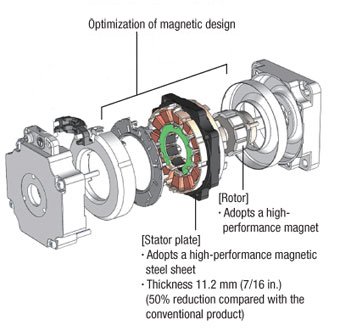
A brushless DC motor is a brushless, electronically commutated permanent magnet (PM) motor that typically uses multi-pole, 3-phase windings in its stator and permanent magnets on the surface of its rotor. A driver is required to energize its stator phases in a controlled sequence. Typically, hall effect sensors and encoders are used to close the loop to provide the logic and speed regulation. In other cases, the driver uses the motor's back EMF in sensorless mode. The design and construction of the motor is similar to an AC permanent magnet synchronous motor (PMSM), which also uses 3-phase windings and permanent magnets.
The controlled stator phase excitation sequence causes the rotor to follow the rotating magnetic field in the stator and rotate continuously at the commanded speed (RPM). The commutation method can be either square-wave (trapezoidal) commutation for standard performance or sine-wave commutation (Field-Oriented Control) like an AC PMSM motor for more precise current control and smoother performance.
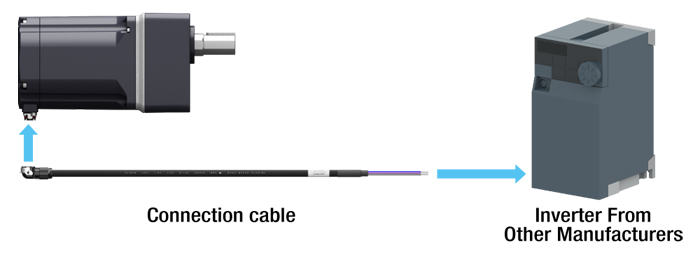
Unlike brush DC motors, which also use permanent magnets, brushless DC motors do not use brushes, so no brush maintenance is required. Brushless DC motors are specifically paired with a dedicated driver for specific frame sizes, but some are also compatible with certain VFDs from other brands.
|
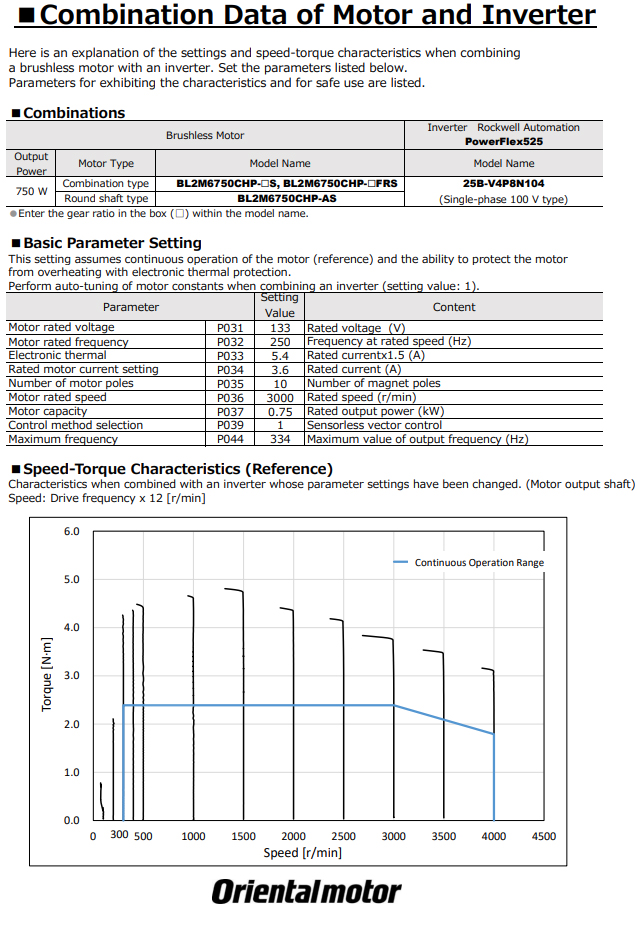
Tech Tip: What is a VFD, and What Types of Motors Can a VFD Drive? A variable frequency drive (VFD) is an electronic motor drive that converts fixed-frequency, fixed-voltage AC to variable-frequency, variable-voltage AC to control the speed and torque of an AC motor. It's most commonly used with 3-phase squirrel-cage induction motors, but it can also drive 3-phase wound-rotor induction motors, synchronous motors (ie: PMSM), and sometimes single-phase AC induction motors. With the right architecture and operation mode, certain VFDs can also drive DC motors, such as brushless DC permanent magnet (PM) motors. ⚠️ Most VFDs are set up to run in open-loop control with AC induction motors by default. Using a VFD with a brushless DC motor without changing its settings may result in poor performance or instability, so make sure you're using a VFD/inverter that can drive brushless DC or PM motors, and set it to the right control mode or motor type. Refer to the manufacturer's datasheet for the specific parameter settings. To enable feedback control, connect your feedback and switch from open-loop V/f control to motor-position-based electronic commutation. |
How Brushless DC Motors Differ from Induction Motors
A major difference between brushless DC and induction motors is how the magnetic flux is generated. Since induction motors do not use permanent magnets, the rotor's magnetic field is generated by inducing a current in the rotor. This method is inefficient and decreases torque density, generates more heat, and increases the size of AC motors. A slip is also created between the stator field speed and the rotor speed, which makes AC motors less synchronous than brushless DC motors.
Design Differences Between a BLDC (PM) Motor and an AC Induction Motor
| Feature | AC Induction Motor | BLDC (PM) Motor |
|---|---|---|
| Footprint | ❌ Requires larger motor and VFD enclosure | ✅ More compact system designs possible |
| Rotor design | ❌ No magnets | ✅ Uses permanent magnets |
| Rotor losses | ❌ Copper losses present | ✅ Minimal |
| Slip | ❌ Required | ✅ None (synchronous) |
| Torque Density | ❌ Low torque density | ✅ High torque density |
| Efficiency | ❌ Low (especially at partial load) | ✅ Higher due to magnets |
| Heat Generation |
❌ Higher (especially at low speeds); often requires shaft-mounted fans |
✅ Lower; also fanless due to lower losses and lower operating temperature |
| Operating Principle | ❌ Torque produced by induced rotor current (requires slip) | ✅ Torque produced by permanent magnets on the rotor (synchronous) |
How Do Brushless DC Motors Resolve Common Challenges of AC Motors?
 |
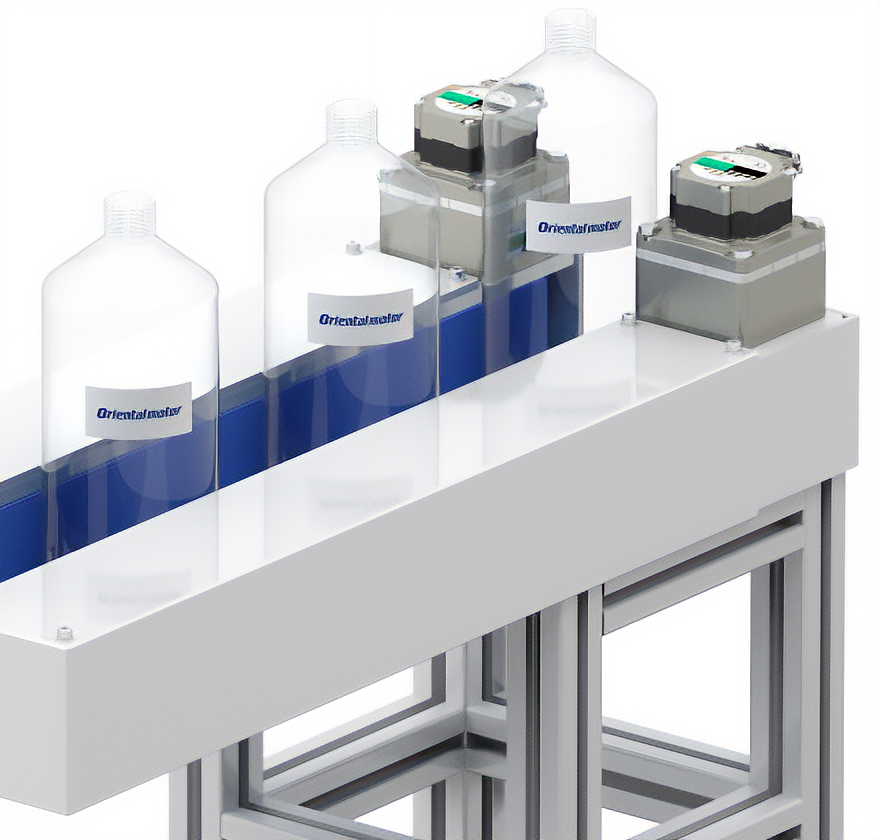 |
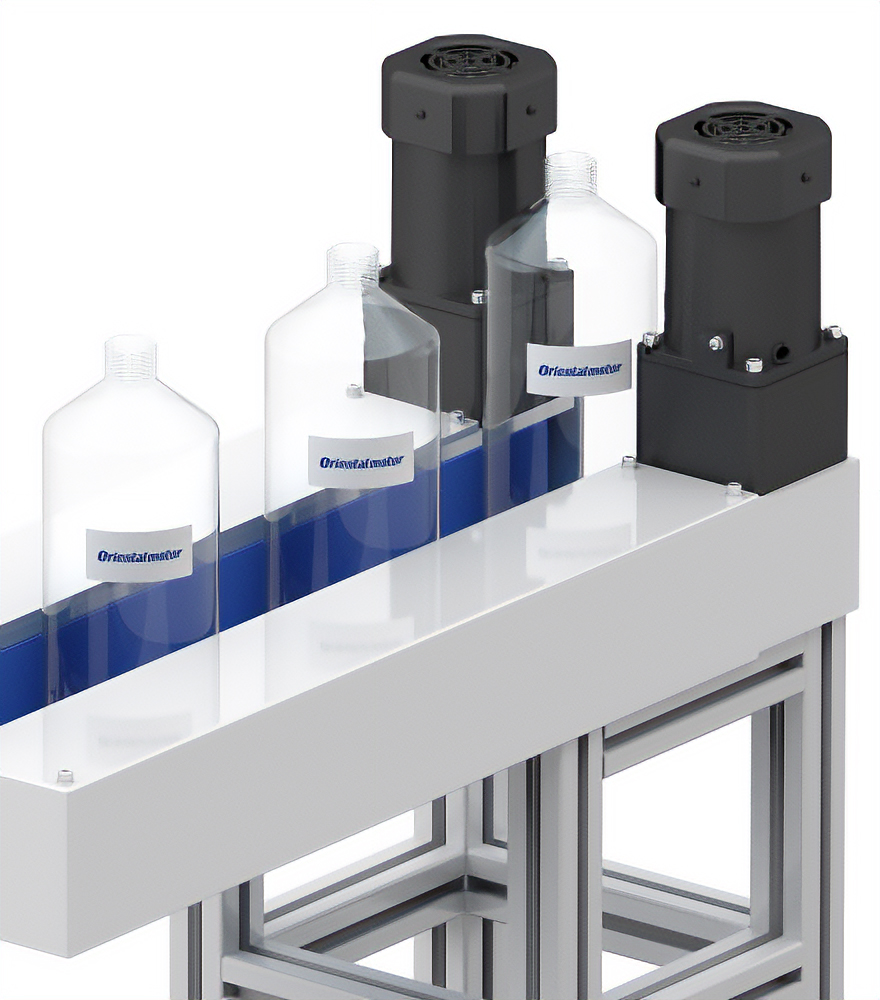
Due to their design and characteristics, brushless DC (PM) motors resolve most of the common challenges presented by AC motors. Most noticeable is the size difference between the motors, but there are several reasons.
👍More Compact Systems
Because permanent magnets provide the rotor's magnetic field:
- No rotor excitation current is required
- Higher torque density is possible
- Smaller motor frames can deliver equivalent torque
In many cases, engineers can reduce overall system footprint by replacing AC motors and VFDs with smaller brushless DC motors and matched drives. For example, a 1 HP brushless DC motor can be 90 mm shorter and 10.2 kg lighter than a 1 HP AC motor. In many cases, the brushless DC driver can also be smaller than a VFD.
👍Lower Noise
Brushless DC motors typically:
- Run cooler due to reduced losses
- Do not require built-in cooling fans
- Can be designed without external cooling fans
With approximately 20 dB reduction, this makes brushless DC motors especially attractive for quiet environments and applications where airflow is undesirable (ie: medical, food processing, or clean rooms).
👍Higher Energy Efficiency
With no rotor copper losses:
- Electrical efficiency improves
- Less heat is generated
- Performance remains consistent at variable speed and partial load
For systems that run many hours per day or operate under energy constraints, the efficiency gain alone can justify considering a brushless DC motor. Replacing an AC motor with a brushless DC motor can result in a decrease of $89/year per motor.
👍Better Control at Low Speed
Electronic commutation enables:
- Precise speed regulation
- Fast acceleration and deceleration
- Strong low-speed torque without slip
Many VFDs cannot run AC motors below 90 RPM while brushless DC motors have no problems operating close to 0 RPM. This is especially useful in indexing, positioning, and variable-speed automation tasks where slow speeds are required.
👍Keep Your VFD
With the right architecture, certain VFDs can be set up to run brushless DC (PM) motors. This means:
- Upgrade your motor without changing your preferred controls
- Flat torque characteristics and wider speed range
- Lower power consumption and motor temperature
Many brushless DC motor manufacturers offer their own drivers. If the existing VFD is preferred, there's an option to upgrade just the motors. The key is selecting a VFD that's also compatible with brushless DC (PM) motors. For help with compatibility or settings, please contact the manufacturer of the motor or the VFD.
This video compares a 1 HP AC induction motor with a 1 HP brushless DC motor.
Performance Differences Between a BLDC (PM) Motor and an AC Induction Motor
| Category | AC Induction Motor with VFD | BLDC (PM) Motor with VFD |
|---|---|---|
|
Upfront Cost |
✅ Lower motor and drive cost | ❌ Higher motor + dedicated drive cost |
|
Efficiency (Rated Load) |
❌Good at or near rated speed and load | ✅ Very high at rated conditions |
|
Efficiency (Partial Load) |
❌ Drops significantly at reduced speed or light load | ✅ Maintains high efficiency across wide speed range |
|
Torque Density (Size/Output) |
❌ Larger frame for same torque | ✅ Higher torque density → smaller, lighter motors |
|
Noise |
❌ Fan noise and PWM‑related acoustic noise possible | ✅ Generally quieter; smoother torque |
|
Vibration |
❌ Can increase at variable speed or low frequency | ✅ Typically smoother, especially at low speed |
|
Variable Speed Control |
❌ Good, but frequency‑based; low‑speed control depends on tuning | ✅ Very fine speed and torque control via electronic commutation |
|
Low-Speed Torque |
❌ Limited without advanced vector control | ✅ Strong low‑speed torque without slip |
When to Choose Brushless DC vs. Induction Motors
The decision ultimately depends on your application priorities. Here's a practical breakdown.
|
✅ Choose BLDC Motors When: |
✅ Choose Induction Motors When: |
|
👍 High efficiency is needed at variable speeds or partial loads 👍 Space is constrained and high torque density is valuable 👍 The application requires precise speed or torque control 👍 The system is battery-powered or energy-limited 👍 You want low noise, reduced heat, and low maintenance |
👍 Lowest upfront cost is the main constraint 👍 The system runs mostly at constant speed 👍 You need a rugged and industrial solution 👍 Efficiency at light load is not critical 👍 Control precision requirements are minimal |
Besides the obvious AC vs DC power supply difference, AC induction motors and brushless DC motors can be used for the same applications, such as conveyors and pumps. The difference is that these conveyors and pumps can be made smaller, less noisy, and more efficient with brushless DC motors.
Instead of selecting based on specifications alone, take a system-level approach and compare motor options against your actual load curve, duty cycle, and drive requirements. An induction motor can still be practical and cost-effective for many industrial applications, but a brushless DC motor delivers long-term energy savings and performance gains that eventually overcome the initial upfront costs.
If you're designing a new system or upgrading an existing one, aligning motor choice with real operating conditions (not just peak specs) will ensure optimal performance and ROI.
|
Recommended Product Oriental Motor's Brushless DC Motors for Inverters are tested with popular 3rd-party inverters. The lineup includes 120 W (1/6 HP) to 750 W (1 HP) round shaft motors, parallel shaft gear motors, and hollow shaft flat gear motors.

Need a higher IP rating? We also offer an IP69K rated stainless steel 200 W (1/4 HP) BLDC gear motor (part of BLE2 Series). |
Related articles:
Head-to-Head: 1 HP BLDC Motor vs 1 HP AC Induction Motor
VFD vs BLDC: Which Technology is Better for Speed Control?
Brush DC Motors vs Brushless DC Motors: Which is Better?